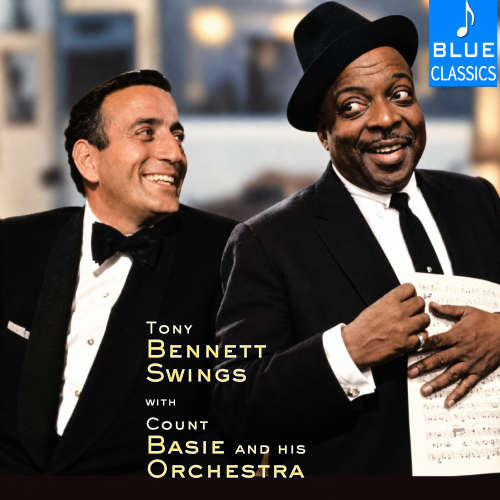
 Tony Bennett Swings with Count...
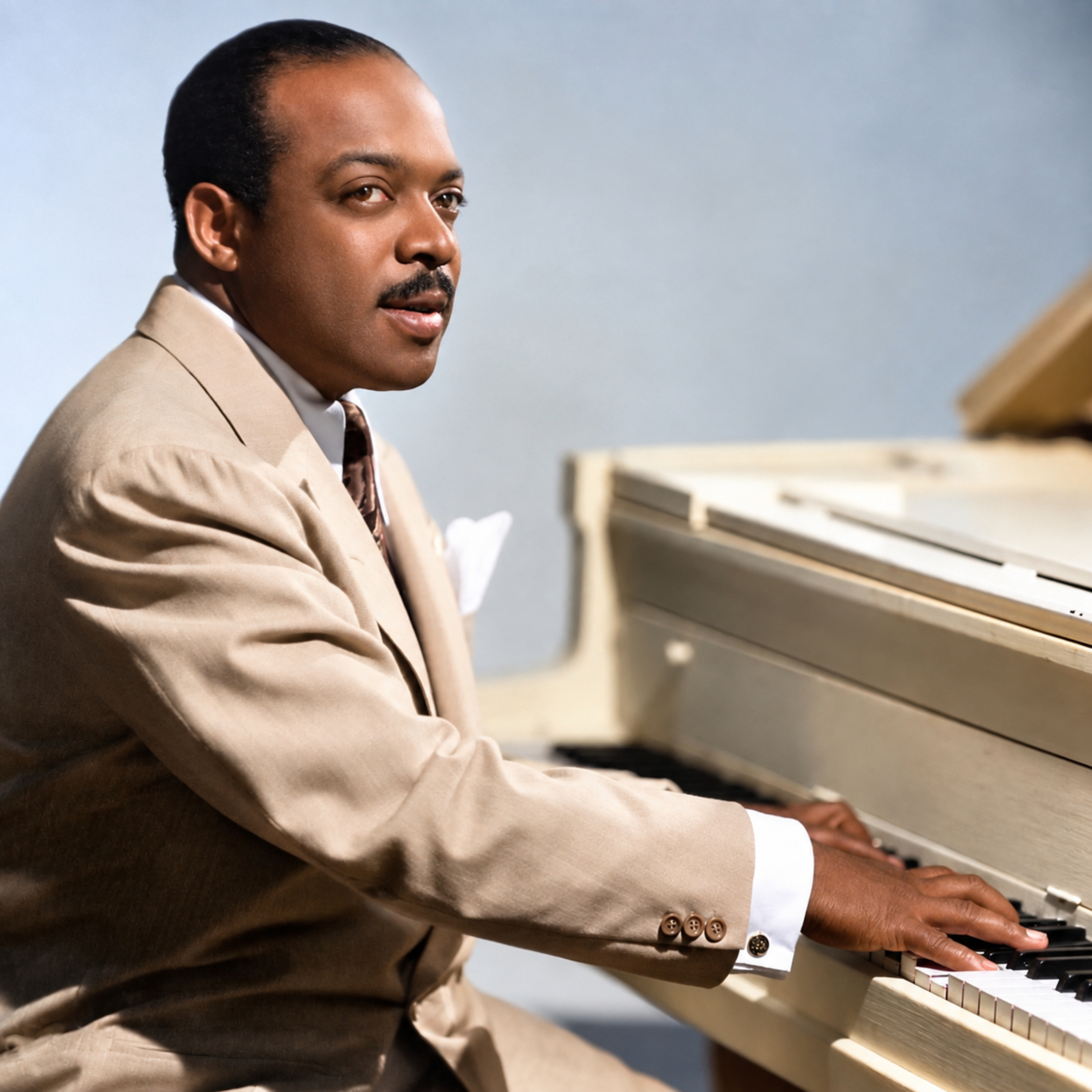
Count Basie - piano & bandleader
Count Basie (b. August 21, 1904, Red Bank, NJ – d. April 26, 1984, Hollywood, FL) was born William James Basie. Over a career spanning roughly six decades, he developed from a young pianist accompanying silent films and vaudeville performers into the leader of one of the most enduring orchestras in jazz. His music became closely associated with Kansas City swing: economical piano playing, blues-based phrasing, strong rhythm, riff-driven arrangements, and a remarkable ability to give individual musicians room to improvise.Basie grew up in a musical family. His mother, Lillian, played piano and gave him his first lessons, while his father, Harvey Lee Basie, worked as a coachman and groundskeeper and had also played music. As a boy, Basie became fascinated by the musicians working in the pit orchestras of local theaters. He initially had an interest in drums, but piano gradually became his principal instrument. He developed a remarkable ear and was able to reproduce melodies he heard. His mother paid for his early piano lessons, while much of his practical education came from listening and playing.
Basie did not follow a conventional academic route. He left school while still young and became increasingly involved in the entertainment business, initially working around theaters and vaudeville. His early professional experience included playing piano for silent films, where he learned to accompany action and mood instinctively. He also worked as an accompanist and traveled with vaudeville performers. Around 1924, he went to New York, which at the time was the center of a rapidly developing jazz scene. There he encountered Harlem pianists including James P. Johnson, Fats Waller and Willie “The Lion” Smith. Fats Waller also introduced him to organ playing.
Basie spent much of the mid-1920s moving between jobs and touring engagements. He worked on the Theater Owners Booking Association, or TOBA, circuit and learned the realities of life as a traveling musician. In 1927, while touring with Gonzelle White's group, a canceled engagement left him stranded in Kansas City, Missouri. The setback proved decisive. Rather than returning immediately to New York, Basie stayed in Kansas City and became increasingly involved in the city's musical community.
Kansas City in the late 1920s was home to a highly competitive musical culture built around dance bands, blues, jam sessions and extended performances. Basie first became associated with Walter Page's Blue Devils, joining the group in 1928. The band included musicians who would later become important figures in Basie's own orchestra, among them bassist Walter Page, singer Jimmy Rushing and trumpeter Oran “Hot Lips” Page. Basie's time with the Blue Devils introduced him more deeply to the large-band sound and to the rhythmic and improvisational practices that would define his later music.
In 1929 Basie joined Bennie Moten's Kansas City Orchestra, at that point one of the leading Black bands in the Midwest. Moten himself was a pianist, and Basie initially had to find a place within an organization led by another strong keyboard player. He became increasingly useful as an arranger and substitute pianist, although he was not yet a conventional written arranger in the later sense. His musical strength was his ear and his understanding of how a band should sound.
Moten died unexpectedly on April 2, 1935. Basie briefly worked as a solo pianist before putting together a small group that gradually developed into a nine-piece band. Among its members were Walter Page, Freddie Green, Jo Jones, Lester Young and Jimmy Rushing. The group was initially known as the Barons of Rhythm and secured a residency at Kansas City's Reno Club. The club became the crucial setting in which Basie's musical identity as a bandleader emerged.
The Reno Club performances were broadcast by radio. During one of these broadcasts, an announcer decided that “William Basie” needed a more distinctive introduction and referred to him as “Count” Basie. The name stayed with him. Other stories have circulated about the origin of the nickname, but Basie's own recollections and later accounts emphasize the role of the radio announcer.
One of those broadcasts was heard by John Hammond, the influential writer, producer and talent scout. Hammond traveled to Kansas City to hear Basie's band in person and became one of its most important advocates. He helped bring the group to the attention of booking agents and record companies. In 1936, Basie and his musicians went to Chicago, where they made their first recordings. The band subsequently moved to New York and recorded for Decca under the name Count Basie and His Orchestra.
Basie's arrival in New York coincided with the rapid expansion of the swing era. His orchestra's first New York appearance at the Roseland Ballroom during Christmas week of 1936 was not an immediate triumph, but the records quickly established the band's identity. The recording of “One O'Clock Jump” in 1937 became one of the orchestra's defining pieces and was later recognized by the Grammy Hall of Fame.
The Basie orchestra developed a sound that was notably different from the more elaborate arrangements associated with some other large bands. Basie's piano was sparse rather than dense. He often used only a few notes, small rhythmic figures and strategically placed chords. The economy of his piano playing left room for the orchestra, particularly for its soloists.
The rhythm section became central to this sound. Walter Page on bass, Freddie Green on guitar and Jo Jones on drums developed an exceptionally cohesive rhythmic foundation, while Basie's piano interacted with them rather than dominating them. The band also relied heavily on riffs—short musical figures that could be repeated, layered and reshaped around improvised solos.
Among the most important personalities in the late-1930s orchestra was tenor saxophonist Lester Young. Young's relaxed, linear approach became an important part of the band's sound, contrasting with the heavier, more aggressive approaches of some other tenor players of the period. Trumpeters such as Buck Clayton and Harry “Sweets” Edison, trombonist Dicky Wells, and singer Jimmy Rushing also became central to the band's identity.
The orchestra recorded extensively for Decca and became one of the best-known dance and jazz bands in the United States. Basie compositions and pieces associated with the band included “Jumpin' at the Woodside,” “Every Tub,” “Taxi War Dance,” “Blue and Sentimental” and, above all, “One O'Clock Jump.” The band's repertoire also included blues, popular songs and arrangements built around the personalities of its soloists.
By the end of the 1930s, Basie was firmly established. The orchestra toured widely and appeared in major ballrooms and theaters. It also participated in films. In 1943, Basie and his orchestra appeared in five movies released within a relatively short period: Hit Parade, Reveille with Beverly, Stage Door Canteen, Top Man and Crazy House.
The 1940s brought both continued artistic activity and enormous changes to the American music business. The Basie band continued recording and touring, but wartime conditions affected the economics of big bands. Musicians were drafted, travel became more difficult and entertainment economics changed.
Basie nevertheless maintained a substantial orchestra through much of the decade. His music became increasingly dependent upon written arrangements, although improvisation and the freedom given to individual soloists remained fundamental to the band's character. At the center of the rhythm section, Basie's spare piano continued to function more as a source of timing, punctuation and harmonic direction than as an elaborate solo instrument.
In 1942, Basie married Catherine Morgan, a dancer with the Whitman Sisters. Their marriage lasted until her death in 1983. They had a daughter and later adopted two sons. The family eventually maintained a home in the Bahamas.
Basie also became increasingly involved with singers. Jimmy Rushing had already been a major part of the early orchestra, while later vocalists, most importantly Joe Williams, became closely associated with the band. Williams joined in the early 1950s and helped define its renewed postwar sound.
After the war, the economic environment for large jazz orchestras became increasingly difficult. By 1950 the situation had become unsustainable, and Basie was forced to disband the big orchestra. This was one of the major low points of his career. For roughly two years he worked with smaller groups, usually between six and nine musicians. It was a pragmatic response to the economics of the period rather than an abandonment of his musical identity.
This small-group period is important because it demonstrates that Basie's career was not simply a continuous sequence of big-band successes. The early 1950s were a period of adjustment. The economics of the big-band era had changed, and the swing orchestra that had seemed to represent the future a decade earlier was no longer an easy proposition.
By 1952, however, Basie was ready to rebuild. He assembled a large orchestra that became known retrospectively as the “New Testament” band, in contrast to the earlier “Old Testament” orchestra. The new band began a residency at Birdland in New York and quickly established itself. Among the important new personnel were Frank Foster, Frank Wess, Thad Jones, Eddie “Lockjaw” Davis and, later, Joe Williams.
The rebuilt orchestra was not simply a recreation of the 1930s band. It represented a different era. The arrangements were more carefully developed, the horn sections often more tightly organized, and Basie increasingly worked with professional arrangers. Yet the underlying principles remained: swing, space, blues feeling, rhythmic precision and strong individual soloists.
One of the defining recordings of this period was April in Paris, recorded in 1955 and released in 1956. The album became an important statement of the revitalized Basie orchestra. The title track developed into one of the band's most recognizable arrangements, especially through its famous final shout chorus.
Basie's return coincided with a broader revival of interest in large-band jazz. During the second half of the 1950s he became a regular recording artist and an international touring figure. He also entered into important relationships with singers and other major figures in popular music.
His recordings with Frank Sinatra were particularly significant. The collaboration produced a combination of Sinatra's relaxed vocal phrasing and Basie's highly controlled swing. Basie also worked with Ella Fitzgerald, Sammy Davis Jr., Tony Bennett and other singers, demonstrating that his orchestra could function equally well as a jazz ensemble and as a sophisticated accompaniment for vocalists. The National Endowment for the Arts specifically notes his important recordings with Sinatra, Davis and Bennett.
Basie's relationship with Tony Bennett led to two important projects at the end of the 1950s, In Person! and Basie Swings, Bennett Sings/Strike Up the Band. These recordings placed Bennett's highly individual vocal style against Basie's orchestra and helped demonstrate how naturally the band could support a singer without overwhelming him.
Basie's own piano remained distinctive throughout. His playing was economical, rhythmic and highly selective. He could sometimes appear almost absent from the texture, contributing a small chord or a few notes at precisely the right moment. The effect was not emptiness but space. He understood that a big band did not need constant activity to create movement.
The late 1950s also brought increasing recognition. Basie was among the first recipients of major Grammy recognition when the awards were introduced in 1959. He was nominated for both Best Jazz Performance by a Group and Best Jazz Instrumental Album for Basie.
During the 1960s Basie continued touring and recording at a remarkable rate. Jazz itself was changing rapidly. Hard bop, modal jazz, free jazz, soul jazz and other approaches were developing, while the commercial environment for large swing orchestras remained uncertain. Basie nevertheless stayed with the orchestra format rather than shrinking permanently into a small group.
His band remained active in clubs, concert halls, festivals and international tours. Basie traveled extensively outside the United States, taking the orchestra to Europe and other parts of the world. His autobiography, Good Morning Blues, later recorded numerous stories from those years involving musicians, touring, recording sessions and life on the road.
The orchestra's repertoire also changed. Basie increasingly incorporated contemporary compositions and arrangements while preserving his characteristic rhythmic sound. Arrangers such as Quincy Jones, Neal Hefti, Frank Foster, Thad Jones, Benny Carter and Sammy Nestico contributed to different stages of the band's later development.
Basie remained open to collaborations with musicians of different generations. He could work with mainstream vocalists, jazz soloists and younger arrangers without losing the basic identity of the orchestra. This ability to adapt was central to his longevity.
The 1970s were a more complicated period. Basie was now in his sixties and had already spent decades on the road. The orchestra remained active, but the musical environment had changed substantially. Rock and fusion dominated much of the commercial market, and traditional big-band jazz was no longer at the center of popular music.
Yet Basie continued working. He made albums with musicians including Zoot Sims and recorded for a variety of labels. His later work did not depend on trying to compete with contemporary rock or fusion. Instead, he continued to develop his established musical language.
His 1970s recordings nevertheless show a musician willing to work with different personnel and settings. In 1975 he recorded The Basie Big Band for Pablo, continuing an association with producer Norman Granz. Albums such as Basie and Zoot, Prime Time and On the Road brought Grammy recognition during this later period.
Basie's health began to deteriorate during the second half of the decade. He suffered a heart attack in 1976 and also developed diabetes. His health nevertheless did not immediately end his career. He continued leading his orchestra, sometimes from a wheelchair, and his performances remained an important part of his life.
His private life remained relatively stable compared with the turbulence experienced by many musicians of his generation. Basie and Catherine spent considerable time in the Bahamas, and he developed a reputation for enjoying horses, western films and electric trains away from music. Catherine died in 1983, shortly before Basie's own death.
Basie's public recognition continued in his final years. In 1981, he received the Kennedy Center Honors, reflecting recognition not only of his recordings but of his broader contribution to American cultural life.
Even in declining health, Basie remained connected with the orchestra. His last years were marked by physical limitations, but the band continued to work under his leadership for as long as he was able. The Washington Post reported that he continued as an active bandleader until shortly before his death and appeared at Wolf Trap shortly before his 79th birthday.
Count Basie died on April 26, 1984, at Doctors' Hospital in Hollywood, Florida. He was 79. The cause of death was cancer, following a period in which he had already been affected by heart disease and diabetes.
His death did not end the history of the orchestra he created. The Count Basie Orchestra continued to perform under subsequent leaders, preserving a repertoire and musical approach that had originated with Basie in Kansas City nearly fifty years earlier. The orchestra remains active, with later generations of musicians continuing to perform arrangements associated with the Basie tradition.
Basie's musical legacy is unusual because his most recognizable instrument was, in a sense, not the piano but the orchestra itself. The National Endowment for the Arts describes his arrangements as vehicles for soloists such as Lester Young, Buck Clayton, Sweets Edison and Frank Foster, while also emphasizing the distinctive simplicity of his piano playing.
His approach was based on restraint rather than accumulation. Where other bandleaders could fill every measure with sound, Basie understood the effect of leaving room. The rhythm section created an exceptionally stable pulse; the horns could build riffs and sectional figures; soloists had space to speak; and Basie's piano could intervene with a few notes that changed the direction of an entire passage.
That musical philosophy survived several periods in which it might easily have disappeared. The first major orchestra struggled through the economic conditions of the early 1950s and had to be dismantled. Basie rebuilt it. The swing era declined. Basie continued. New styles appeared. He adapted without abandoning the basic language of his orchestra. His own health deteriorated. He continued as long as he could.
Count Basie's life therefore contains several different chapters: the Red Bank childhood; the apprenticeship on the vaudeville circuit; the formative years in Harlem and Kansas City; the rise of the Reno Club band; the discovery by John Hammond; the arrival in New York; the Decca years; the flowering of the Basie orchestra during the swing era; the difficult small-band years around 1950–51; the rebuilding of the orchestra in 1952; the major recordings and international touring of the 1950s and 1960s; the later collaborations and Grammy-winning recordings; and finally the years of declining health in which he continued to lead his band.
The autobiography Good Morning Blues, written with Albert Murray, is particularly valuable because it presents Basie's own recollections of these periods, from childhood and vaudeville through Kansas City, New York, recording sessions, touring and his encounters with musicians including Fats Waller, Lester Young, Frank Sinatra and Tony Bennett.
Count Basie's career ultimately demonstrates the possibilities of continuity in jazz. He did not need to reinvent his musical identity every decade. Instead, he allowed the personnel, arrangements and repertoire to change around a stable rhythmic and aesthetic foundation. His orchestra could play blues, popular songs, extended instrumental pieces or accompany a singer, yet the musical character remained recognizably his.
The result was a career that lasted from the silent-film era to the final years of the big-band tradition, encompassing vaudeville, Kansas City jazz, swing, postwar popular music, television, international concert touring and the modern jazz recording industry. Basie remained at the center of it by understanding something fundamental about ensemble music: sometimes the most important musical decision is not what to play, but what to leave room for.